Showing posts with label west berlin travel tips. Show all posts

Sunday Walk in Pichelsberg

Caught between the noisy Olympia Stadium - especially when there is a soccer match going on, as yesterday - Spandau and Gatow, Pichelsdorf is one of those place you rather transit through than you stop. Without museums and any noteworthy restaurants or monuments, you rarely find it mentioned by the everyday Berliners, unless they are (lucky enough) to live there. But I believe in the charm of every single part of Western Berlin, and I am not afraid of the thread of boredom. I am rarely getting bored in this city - and during any of my travels in general - therefore I decided to spend a full Sunday afternoon exploring this part of the city. 


Once we are coming out of the 1911-built SBahn Pichelsberg station, all we can see are small one-storey houses surrounded by green yards and huge old trees. This is the predominant architectural style of this villa-residential area. 
Close-by, there is the so-called Britishen Siedlung on Kiplingweg, a couple of dozen of houses close to the then British Hospital and the British School - which nowadays is a private English-speaking school. Finished in 1958, by the team of architects Rudolf Ullrich, Alfred Gellhorn and Leo Lottermoser, it was aimed to answer the accommodation needs of the representants of the British Establishment living in this part of the city. Although the constructions look more or less all the same, what distinguishes a residence from the other is the choice of plants and size of the gardens, with the whole area looking almost like an enormous garden.


New blocks of flats are taking over parts of Pichelsberg too, but in a way which keeps in line with - at least - the average height of the surrounding buildings, although all of them are looking like copy-pasted Tetris blocks.  


When you are not having a garden party or an outdoor lunch in your home garden, you can find some small places where to spend your time and money: some small beer gardens or some Italian restaurants. Nothing fancy, minimal comfort and an usual menu, and good prices too. 


On a side street from the very long Heerstraße, it is situated since 1955 the Jewish Cemetery. It was created after the access to Weißensee - Europe's largest cemetery - was blocked following the division of the city. Here are burried personalities like the iconic Heinz Galinski, the leader of the post-War Jewish community in Berlin between 1949 and 1992, the chief cantor Estrongo Nechama and the representatives of the West Berlin Jewish families established in the city in the last decades.


A couple of meters away, on Heerstraße, there is another cemetery: War British Cemetery, one of the three Commonwealth War Centers in or near Berlin. Designed by Philip Hepworth, the principal architect for WWII Commonwealth War Cemeteries and Memorials in N Europe. Around 80% of those burried here - a total of 3,600 burrials - belong to the Royal Air Forces (RAF) Bomber Command. A number of 278 burrials are after the war. It is my second time here and I feel overwhelmed by the general feeling of stillness. No one around, only the thousands of replicated small white stones. 


Out on Heerstraße, the high buildings erected between 1968 and 1970 in order to accommodate the new needs of the West Berliners sprung from the tall trees. 


But the predominant architectural style of the area favors white, one- maximujm 2-storey family houses. Am Rupenhorn displays a couple of examples of architecture from the 1920s. One of the most famous is the building on no. 25 whose interior can be also visited by requests sent at least 2 days in advance.


Nature is inviting every tourn of the street and like the rabbit from Alice in Wonderland, invites to follow unbeaten path. As the entire area is on a small hill - berg means mountain in German, but in this case the term is slightly overrated - you can easily go up and down through small forests to reach small lake oasis or even to go as far as Grunewald - which is around 4 km. away. We are for the lake today, and the small port Am Pichelsee makes me forget for a second that I am only in an obscure part of Berlin and not in Monaco or who knows other glamorous place in this world.


You can easily rent a boat for a couple of hours or a day, if you are not lucky enough to have your own. On the street sides, glued on a tree, small anouncements on pieces of paper - the usual marketing Berlin-style - are offering boats on sale for quite good prices.


Under the massive metal feet of Stoßenseebrücke, both nature and boats and humans are grossly belittled. The association between nature and human work looks like a grotesque display of power.


Remains of former gates of entrance to Berlin add a majestic decay to the landscape. This area can be read in so many ways, from the old times to the industrial revolution era!


Times passed, the nature and their beautiful lakes stay always the same - maybe only a bit polluted by humans from time to time.


Time for a short snack, at a local fast-food establishment since 1961 - Ketch'up. The Frech fries are decent and the garden offers a pleasant oasis of freshness on a sunny day - plus live updates from the soccer championship!


Down on Siemenswerderweg, a short stop at the small boats port. People are waiting in line to rent a boat, with bags fulls of bottles of beer on the side. Cheers for the neverending summer vibes in Berlin!
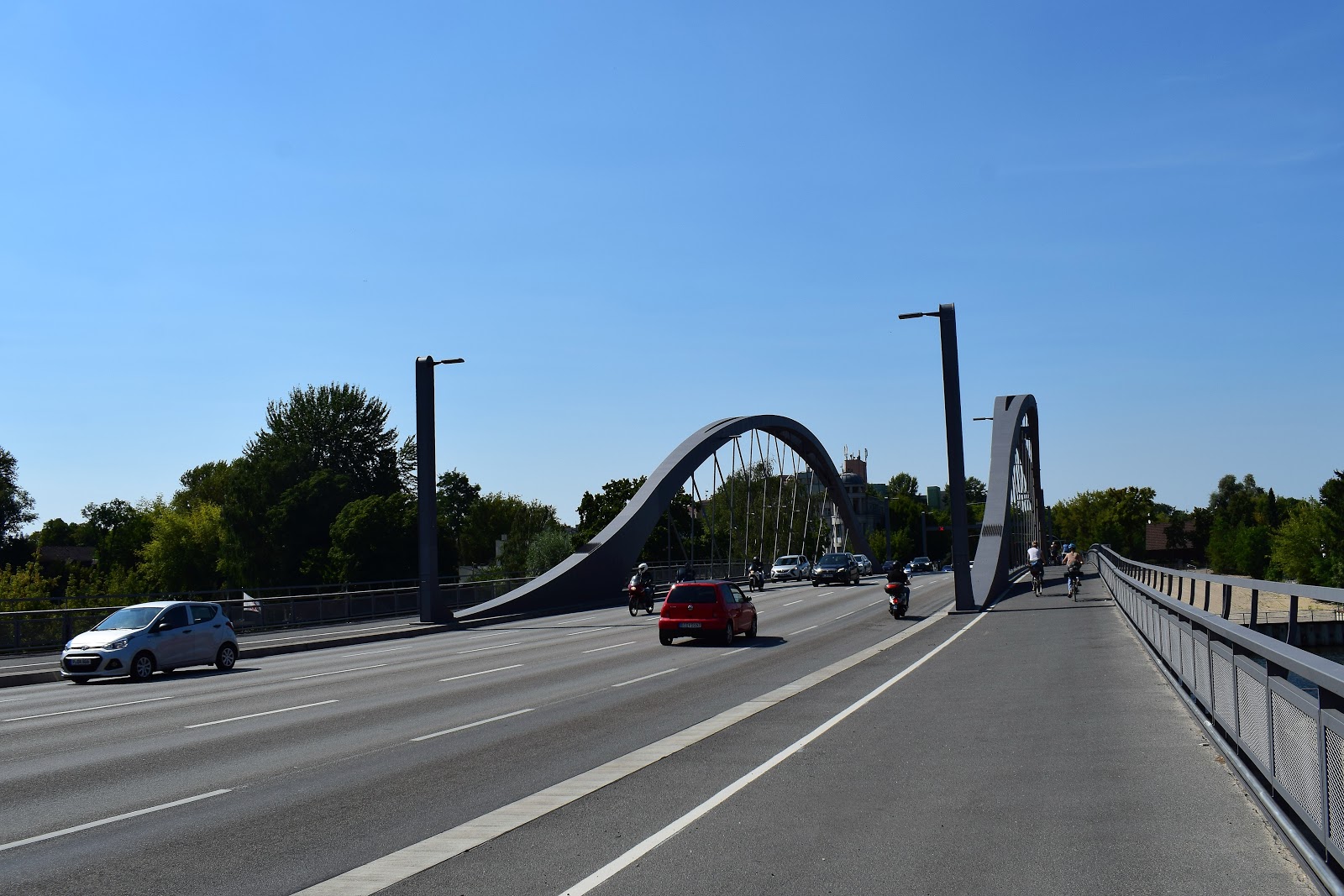

A couple of meters up, the Freybrücke, originally built in 1910 and reconstructed in 1950, brings you - on bike, at the wheel or pedestrian - near to Spandau.


The sophisticated construction of the bridge is countered by the pre-modern view of the surrounding natural view on the lake, where people are stand-up paddling or enjoying the pristine environment.


In Alt-Pichelsdorf, the enormous park is one of the most important highlight of an area where everything is small scale: the little shops, the Späti - small stores open round the day and night - the houses and their gardens.
As we are walking back the 2,5 km. alongside Heerstraße to the S-Bahn station, we stop for a little while more than once to breath a bit more this quiet feeling of slow life. The more I explore the West Berlin the more I realize that I would not be able to live anywhere else in this city.  

For more travel stories, follow my YouTube channel: https://www.youtube.com/@ilanatravels

Where to Have the Best Ice Coffees on Ku'damm

Until now, summer in Berlin was a sour-sweet joke, with full days of rain ending up romantically with awesome sunsets. People living here for more than 20 years complain that this was the worse summer ever, but optimistic people like me still give good weather a chance in the next month. 
However, rain or not, the fancy restaurants keep going on with their schedule and the menus offer special summer treats, such as the ice coffee, which I honestly don't mind to sip it all round the year. But, I rarely have the chance to have one in January or even April, although I dare to ask more than once, taking the risk of being stared as an excentric unadaptable creature. Compared to the 'real' coffee, there is something I always associate with an ice coffee - can I have it, please, really cold, topped with cream, with some sprinkles of cocoa if possible (coconut shreds are also a good idea), with the icecream softly melting and taking over the sourness of the coffee: people watching. I love to indulge once in a while something sweet and diabetically addictive, while leaning on the summer chairs on my favorite part of Berlin: the fancy Kürfurstendamm (Kü'damm). From tourists to old and new Berliner, the entire social network of my beloved city is running back and forth, faster or in slow tempo, in the front of me and my excentric glass of ice coffee. 
For those sharing the same secret temptations, I bring you my favorite spots on Ku'damm. If someone, anyone, ever needed a proof that my life is anything else but series of coffee hopping, here you have the proof. 
The average price of one ice coffee is around 5.50 EUR.
Opposite Halensee S-Bahn station, at no. 115, near Henriette Platz, there is a West Berlin ice coffee institution: Eisgrün Eis-Café. Open until 22.00 during the summer time, it has a huge offer of delicious icecreams many of them easily added to the special menus. I am trying to visit this place at least once the year, for one full lazy hour of people watching. This time, I ordered Mocca d'Oro: a shot of espresso, with vanilla icecream, cream liqueur and a lot of cream, plus some elegant sprinkle of cocoa on the top. The best answer to a sweet tooth. 
A couple of meters away, there is time for another delicious spot: Zeitlos (timeless, in English) cocktails bar. I never been there before until this yeaar, as I was assuming it is too touristic, but my curiosity about their ice coffee was too big to resist. The ice coffee is not on the menu - which has a lot of temptations of summer fresh cocktails among others -, which means that there is only one single type of it. It has the vanilla icecream, and the heavy whipped cream and you need to mix them slowly until they are one with the sour cold coffee. A moderate experience, but a good threat for the summer. 
After soo much sweetness, that infused your body with energy too, you dare to walk a bit more, until the Häagen-Dazs elegant store, at the ground level of the famous 4-star Hotel California. There is another similar store, but smaller, at the very beginning of Ku'damm, direction Zoo, and another one, where I had my first salted caramel ice coffee a couple of years ago, in Hackischer Markt. I love the view there, and the ice coffee offers the usual combination which you can make it even sweeter ordering one of the many icecream sweet - or very very sweet - crunchy combinations. Every time I go to the outdoor terrace, the service was quite messy, but the street view has a calming effect while waiting to be brought the right or the slightly delayed order.
Reinhard's by Kempinski is my favorite place to an stay a bit longer than usual, watch and elegantly sip my ice coffee. This year, the ice coffee seems to be a bit less successful than in 2017: something happened with the coffee taste which was less rich that I expected, but maybe it was a bad coffee day when I visited. Therefore, I have to give it at least one more try, until the summer is over. 
On the other side of the street, Hard Rock Cafe is always busy with people waiting in line in the front of the entrance, especially in the summer. Especially if you want to seat outside, on the terrace, expect some delays unless you want to make a reservation. They do have the classical American ice coffee - which is cofee on ice - but also some Irish cream whisky sortiment. 
Last but not least, a spot which I don't fancy for the view - actually it has the worse view - and looks pretty cheap, with its plastic red chairs: Europa Center. The ice coffee looks and tastes good and the service is pretty fast. I particularly loved the good balance between the sweetness of the whipped cream and the sourness of the coffee. And it is as cold as you expect it after a whole day of summer heat. Which summer heat, I am still looking forward to it, probably in August. 

Naturpark Schöneberg - Berlin's best kept secret

After so many years of intensive Berlin life, when I assume I know about almost every single secret corner of the city, it is a big event to discover something new. However, instead of complaining about the long gray days and sparse light hours, I decided to surprise myself and try finding unique ways for some short baby walk and photographic opportunities. Thus, I stumbled upon Naturpark Schöneberg, apparently one of the best kept secret around.
The park can be reached by foot from Priesterweg S-Bahn station. A colourful yellow stone-arched entrance guarded by a metal tower makes the entrance into a huge natural space with industrial-designed items spread all over the view.
Pathways covered by leaves in the middle of naked trees take you deep into the heart of nature. Specific signs let you know that on your way you might encounter birds or some little animals. 
The ugly concrete walls of the entrance are creatively decorated with street art, a trademark of Berlin.
The current Naturpark used to be between 1889 and 1952 a rail yard, with its own train station, a stop on the train journey from Berlin to Dresden. Since the 1950s, the area was disaffected from industrial activities and slowly turned into a natural park. 
Inside a huge hall where souvenirs or some mulled wine can be tasted, remains of the older train active times are left, alongside train parts and old rails. 
In order to keep up with the original destination of the place, huge pieces of art made of industrial materials are exhibited in 'Il Giardino Segreto' - The Secret Garden. 
Vivid colours bring life to the monotony and industrial art creatively binding various metal parts, trying to defy gravitation and other usual rules of physics are an invitation to see the world differently, even when there is so much ugliness at the first sight.
Especially for a grown up children, this place can be a place of exploration and discovery. Some of the old trains are left in the middle of the young forest and can be touched. Special tours around the location are regularly organised in the weekends. 
As a solitary independent visitor, you just need to follow the old rail tracks and finding your way is not difficult. The park it is open as early as 9 o'clock and unless there are some cultural happenings or children events organised, the place is almost empty.
I particularly loved the co-existence found between nature and industry, with the vegetation spread among the rails and huge tunnels going nowhere left open for exploration.
Once in a while, there are some observation points from where one can overview the immensity of the place or hope to catch some sign of life of animals or birds nests. The overwhelming silence is regularly cut short by trains coming and going nearby.
Although biking is not allowed, you can easily go with a children pram and with some sport comfy shoes one can have an easy jogging or hiking around the area. 2-3 hours may be enough to see almost everything, but I bet that during the spring the view is more spectacular and full of colours.
The entrance fee for the park is 1 EUR, that in our case was collected by a guy with a mini cart who was driving around the alleys, stopping people and asking the price. 
At the end of the trail, there is another area dedicated to street art, with teenagers working hard to manipulate the spray tubes. Although at the entrance I've spotted some creative work of street art, in this part the predominant style are just tags and non-figurative works, with a few exceptions, not a very impressive record. 
As for now, the December gray is wrapping everything, and only the graffiti colours on the trees are challenging the weather narrative. I just need to be more patient and wait until the spring for a new adventure in Naturepark Schöneberg. I bet there are even more natural treasures hidden around.