Showing posts with label mein deutschland. Show all posts

48 Hours in Stuttgart

The problem with many of the places in Germany I would love to visit is that due to distance, I need to consider more than one-day trip for a serious discovery therefore, everything should be planned in time, mostly if I want to get the best Deutsche Bahn tickets and convenient hotel rates. This year, I started to advance on my list of places to see that are far away from Berlin, starting with Karlsruhe and its cosy neighbouring towns, such as Baden-Baden. Next on the list was Stuttgart, that I longed to see for a long time. After a long 6 hours trip from the capital city, I am here to explore it step by step for 48 hours.
When I arrived there, on a sunny spring day of mid-March, the entire train station was surrounded by massive construction works and finding my way to the hotel via the center was not very easy, especially when I was not sure which way to go out of the workshop maze. Luckily, the impressive construction of the central train station, built between 1911 and 1928 diminished my frustration. The masonry is made of different types of stones, creating a monumental archaic impression. 
With one eye at the statues from the train station and another trying to follow the directions to make my way out of the station I got to the wrong entrance and suddenly found myself in the middle of an architecture mammouth, the Landesbank Baden-Württemberg square, with busy people in elegant suites moving preoccupied from a corner to another of the building. This area looks like the economic heart of the city and I am impressed by the display of steel and glass, embellished from time to time by the cherry blossom trees on the top of the buildings.
The next stop is the famous Stuttgart City Library inaugurated in October 2011, one of the main reasons I wanted to visit this city for such a long time. Projected as the beating heart of the newly emerging neighbourhood, the library from Mäilander Platz is built as a cube with edge length of 45 meters. Inside, it follows the design of an ancient pantheon, the plans being inspired by the work Cenotaph for Newton, by Etienne Boulle, an architectural poetic homage to science. Before and after going to visit and look for a book from one of the neatly organised 8 levels of bookish delight, one can stop at the 1square meter fountain wrapped into the light coming from the top of the ceiling, in an area designed to create a meditative space.
Meditative myself, but also humanly limited by my jealousy of the citizens of Stuttgart, blessed to have access to such a bookish resource, I am strolling slowly the busy shopping areas and the chaise-longues in the front of restaurants taken by people enjoying the generous rays of sun in Pariser Platz. It is time to go back to my route, find my hotel and continue the exploration, although, every couple of meters I am tempted to stop and follow a random street. 
Once I am at the beginning of the 1.2 km long Königstrasse, the vibe of the city catches me. It is Thursday afternoon and tourists and locals are heading from all direction to what it is the beating heart of the consummerist pleasure, institutional decision making - the building of the State Parliament, Landtag is situated nearby - or just walking.
The Marktplatz, with a history coming back to the year 1304, displays a hectic mixture of classical and modern, with shopping centers hosted in temples lookalike buildings and transparent cubes offering a glimpse into the contemporary art trends. As usual in Germany, any sunny day is an opportunity to spend as much time as possible outdoors, in this case on the grass.
Once I am checking in at my hotel, my second, and hopefully more organised part of my trip is about to start. But leaving some place for the unknown is part of my travels, therefore, when I see the small tram that reminds me of Lisbon, at Marienplatz, I don't think twice before I am heading...not sure where. Interestingly, as the city is apparently coping with serious pollution problems, the days when the level of air pollution is high, the costs of the tickets are half, an information generously shared by a local helping me to find the right ticket for my short trip.
After ten minutes of tram ride, when I passing near fantastic photographic corners from where I can have an overview of different parts of the city, I am in the Degerloch part of the city, a relatively quiet area that used to be a religious quarter back in the 12th century.
Back in the city, on the usual touristic route, I am checking various traditional destinations, such as the family brewery Dinkelacker, with experience in producing beer made in Schwabia - the geographical and historical part of Germany to whom Stuttgart belongs - from the 19th century. Tours and other sightseeings of the location are possible, and a big restaurant generously offering local beers and food seems to be always busy with customers.
The architecture and culture lover is rewarded with the view of the Altes Schauspielerhaus - Old Playhouse - an Art Deco structure with Baroque elements with 500 seats. 
Baden-Württemberg is one of the wealthiest parts of Germany, with a high-end economic and banking profile. Therefore, no wonder that an impressive building is dedicated exclusively to economic activities and research. Haus der Wirtschaft is worth a short look even if you are not a rich and successful banker or CEO, because it shows the importance given to research and development, an incentive for the German economy in general.
However, I am superficial enough to look for other manifestation of a successful economy, mainly the good foodie places. Feinkost Böhm is, for instance, such a destination, offering high-end gourmet products, plus a nice bar in the middle where sushi and some champagne is generously available.
For the end of my first day in Stuttgart, I am exploring places on Königstrasse, with its art messages spread between luxury stores and shopping centers. 
Although not in the mood for some shopping experience, I can't miss the occasion to enter the Königsbau Passagen, be it only for its bold architecture. 
And also for a little bit of local sweets, the Cremschnitte, with the yellow cream melting between the fine pastry layers, which vaguely reminds me of some childhood sweet dishes. Unfortunatelly for my foodie reputation, this is the only local food I am trying during this trip. No Maultaschen - the mince filled pasta dish similar to ravioli - no Kasspätzle - the cheesy noodles - not even the Swabian national dish - lentils with noodles. This time I was to busy to explore the city, even on an empty stomach.
On the way back to the hotel, the city is showing its secret corners under the electric lights of the night.
Marktplatz is looking more restrained, now when the tourists and locals are no more out of the street. As a Messestadt, a city regularly hosting international fairs, Stuttgart seems to never sleep, with a constant number of visitors from Germany and all over the world always around checking the local trademarks.
The next day starts early in the morning with an ambitious agenda, that should be adapted to the aggressive rain that will follow my curious steps. I am buying a one-day ticket that will help me move faster through the city - 6.90 Euro - available for both tram, metro and bus. First stop: the TV Tower - Fernsehturm -, a landmark of the city, famous far beyond the German borders. Built 60 years ago, the 217 metre high construction it is the world's first TV Tower, who served as a model for similar constructions in Frankfurt am Main, Dortmund, Johannesburg and China. From the top, one can have an overview of Stuttgart and its surroundings, preferably while having a meal at the restaurant.
Back in the central area, I am running from the rain at the Staatsgalerie, which has an extraordinary collection of old and new art that can keep you busy for long hours. 
My favorite section is dedicated to modern and contemporary artists, such as Chagall or Frank Stella.
The building itself combines various styles, from the classical entrance to the more exuberant and anti-traditional new wing.
Classical in appearance and spirit, the State Ballet is another famous landmark of the city, with a tradition of being on the forefront of international dance for over 50 years. Especially when you are new in town, with a precarious language knowledge, but interested in arts, this place might be the favorite destination for the new expats and Stuttgart is due to its economic and industrial relevance a destination for people from all over the world. 
However, as I noticed myself as an expat in Berlin for over 8 years, you always need a lot of local knowledge if you want to grasp the local culture and symbols. For instance, if you visit any tourist store in Stuttgart, you might notice everywhere two funny figures, a worried donkey and a naive monkey. The two, Äfflen and Pferdle, were the symbols of the local Swabian programs for children in the 1960s, and are still the funny mascots of the city. 
My next destination for the day is in a completely different part of the city, but only five minutes away by train - S-Bahn - from the central area. In a couple of minutes, I am arriving in a heavy industry area, ready for another immersion into the local culture.
The Mercedes Benz Museum, situated at Mercedes Street 100, is at the first sight an architectural landmark, with its sophisticated contrasts between glass, metal and transparent spaces disposed as part of a complex and complicated geometry.
Inside, the view is equally impressive, and leaves a strong memory although you are not interested in cars or Mercedes Benz as such. The exhibition starts at the last level where the visitor arrives in a metal capsule like elevator. It is a real journey through time and history and the way in which the information is displayed, through video, photos and written text make it one of the best museums I ever visited.
I particularly appreciated how the history of the famous German brand car is intervowen with the industrial revolution and the history of the country. The eight levels of the museum unfold chronologically from the beginnings of the 19th century, until our era.
Even if you are not a big fan of vintage cars, it is not easy to ignore the extraordinary impact on the material culture of the Benz and Daimler discoveries. An unique experience through a 125-years timeline, live lesson into the history of innovation displayed through 16,500 square meters.
There is also a car and truck collection, as well as of race cars, disposed on the spires stages of the museum, descending from the last level. In total, there are 160 vehicles and 1,500 exhibits presented, among which historical pieces, such as the boat owned by Bismark, a present from Daimler. 
From the Museum, I am walking a different path to the train, having a view over the Mercedes Benz Arena, home of the local soccer team VfB Stuttgart, the center of the most important sport activities in the city.
I am back in the central area, in the mood to see all the hidden gems around the big shopping alleys. The castle gardens are a pleasant walk, if it doesn't rain too often, as it happened almost every 30 minutes since I started my second day in Stuttgart.
With such a rich cultural offer, there are always things to fill the time between rain showers. The Landesmuseum Baden-Württemberg offers the opportunity to find out more about the culture and history of this part of Germany, for instance.
Schillersplatz with its Haus of Musik, offers a real time display of historical architecture, with local Swabian flavor.
Nearby, the Markthalle invites me to check out some foodie delishes, covering the entire world, including Spain and France, with charcuterie, fine cheeses and wine, a lot of wine...
In the weekend, the flea market from Stauffenbergplatz is generously offering deals of all kinds, or just the opportunity to discover special local and family histories or secrets.
It is never enough walking, as I feel that I still have a couple of things to see here. For instance, the elegant Karlpassage, which reminds me of the elegant KaDeWe from Berlin, with its many international brands and a champagne counter too...
When built in 1956, the city hall building was considered one of the most modern in Europe, with its tower with chime and the geometrical facade. It was built on the grounds of the older structure, a neo-Gothic construction destroyed during the WWII bombings.
Hiding between two brand stores, I finally find also some street art in Stuttgart: a manga wall on Kirchstraße, an interesting sight in this fancy looking area.
If you are visiting Stuttgart, there is another area pulsing with life, recently brought to life: Bohnen Quarter, or the Bean Quarter, a former settlement of tradesmen and wine-growers situated initially beyond the city walls. It acquired its name from poor inhabitants which grew beans in theor gardens. After a massive redevelopment at the end of the 1970s, the area is a lively part of the city, with fancy restaurants, bars and modern apartments. 
Once I've seen most of the city trademarks, I dare to go a bit off the beaten path, following streets and corners I am curious to discover for the sake of the travel adventure. At first sight, I am in love with the colourful Art Nouveau details from Eberthardstraße.
Around Marienplatz, Filderstraße surprises me with some well worked facade details assigned to a high-school.
Close-up decorations, in Art Nouveau style, embelish and bring more humanity to the huge buildings.
I have enough time at hand to notice how the stone high-ground levels and windows are writing an interesting narrative of a street, especially when no one is around. 
As usual, there is a different feeling you have of a city when you are wandering the streets early in the morning. On the way to the train station, I am trying to see even more and catch up some more travel information.
Just before I have to leave Stuttgart - hope not for too long - I have the chance to have a look at the Hegel Haus where the famous philosopher whose conceptions influenced the history of European thoughts in the 19th century was born and lived the first 18 years of his life
My last sight before I say 'good bye' is the Palace Gardens, an elegant architectural display in the middle of a green oasis. I've spent very some very intense 48 hours in Stuttgart but I want to come back to have an even more local feeling. I hope this will happen sooner than later.

48 Hours in Karlsruhe

'What do you want to do in Karlsruhe?', 'Is there anything worth such a long visit there?' my friends asked when I happily announced that I will visit this German city in the land of Baden-Württemberg. I am used with such questions as often friends and acquaintances, many of them born and breed in Germany too, need some time to check on Google the locations I am mentioning as my next travel destinations. I am here in this city relatively unknown in my part of Germany to explore for 48 hours 
My visit coincided with the 14th edition of art Karlsruhe art festival and the central area was jammed by shuttle buses full of artists, critics and simply art lovers hurrying up to the exhibition place. Karlsruhe, an art city? It was a label I didn't find associated too often with this city, but as the art fair is more than a decade old, it seems that I had the wrong bibliography. 
However, while slowly walking the long Karlstraße, I noticed the beautiful entrances decorated with colourful tiles or glass art, which was already a clear sign that the people in this city care about the way in which they live.
Art Nouveau massive buildings added more style to my first walk into the city, with carefully decorated many-storey constructions adorning the side-streets.
In less than one hour, I was gathering more and more visual impressions about the city, and the spring-like sunny day allowed me to add more thoughts while wandering the gardens of the Palace, a classical city destination. Taking the advantage of the sunny day, the city of Karlsruhe is fairly represented on the grass, from small children having their afternoon nap to highschool children playing football or students from the many faculties in the city reviewing their bibliography outdoors.
A couple of minutes later, a new information was added to my travel map: there is a tradition of craftmanship generously displayed at the Majolika factory and museum. From small sculptures to entrance tiles and bowls and plates, the visitors is offered colourful and interesting insights into the local traditions. Now, I know that the beautiful tiles I spotted before were not brought from Portugal or other places, but produced locally.
As the sunny day seems to last more than a couple of minutes - as we experienced in Berlin - so I take the chance for some long walks in the Hardtwald, alongside with many locals of all ages biking, Nordic walking or just walking as we do. As the city is surrounded by forests, the air is so fresh that once, after a couple of hours of rain the air was so fresh that made me feel I am on the top of the mountains. 
Back from my walk, I am heading back to the palace, making a mental note to return later for a serious visit of the modern and antique collections and temporary exhibitions. Interestingly, the building of the palace, in the 18th century, was planned as a very elaborated architectural project. The tower of the palace was situated in the center of the city, with 32 rays - streets - radiating out of it like the lines of a fan, therefore a German nickname of Karlsruhe of 'Fächerstadt' - 'Fan city',
Meanwhile, I continue my first day in Karslruhe discovering streets after streets, not necessarily with a plan. And, as usual in such cases, my eyes are always rewarded with unforgettable views. My camera is having a lot of work to do right now. 
While in the Western part of the city, I notice the classical architecture which applies not only to schools and institutions, but also to houses. 
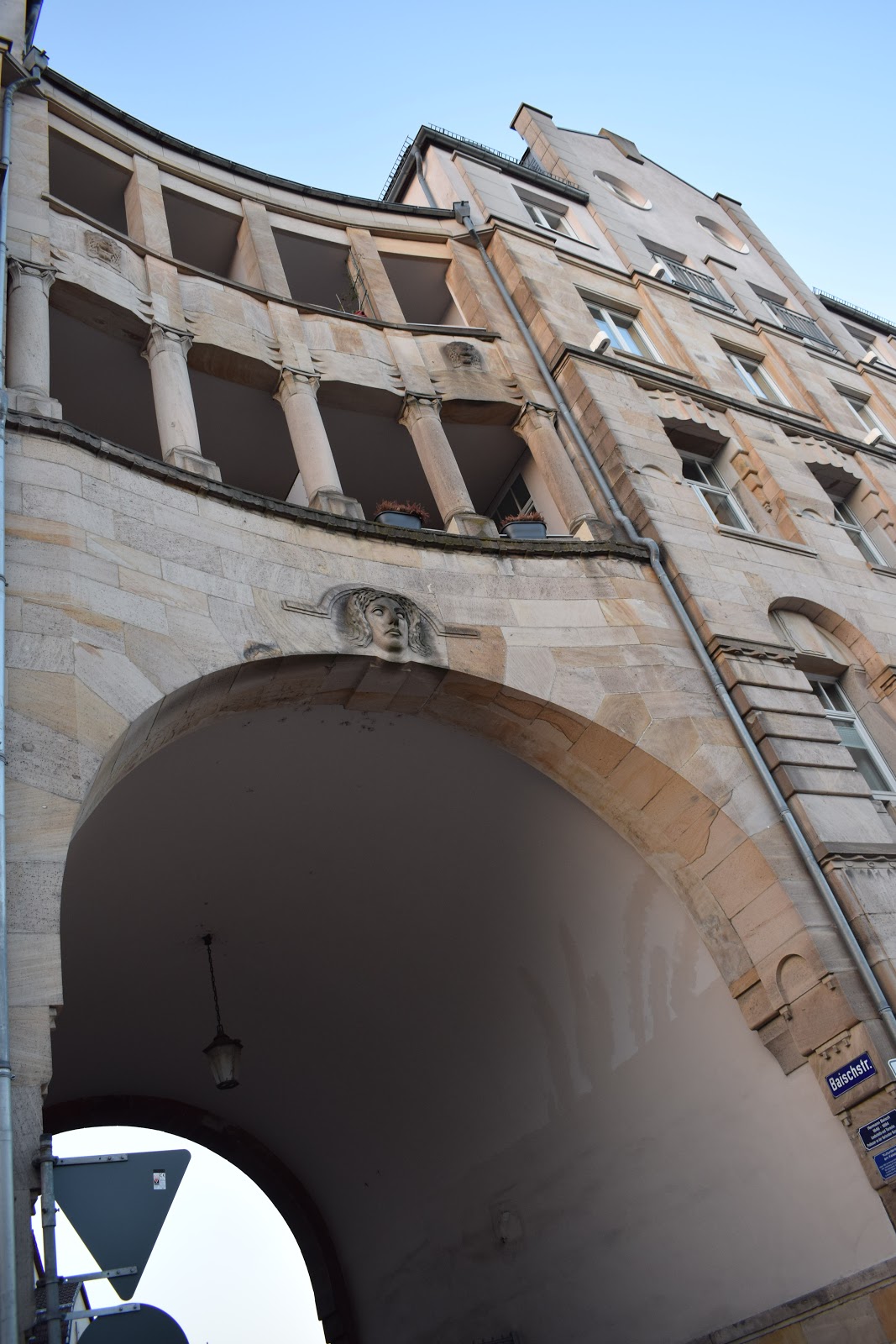
There is always a reward to the curious mind. While returning to the center, I decided to take a side street and after a couple of blocks I am in the front of a massive entrance to what used to be a private street built at the beginning of the 20th century: Baischstraße. The entire project was the idea of the local architect Hermann Billing Baisch, teacher at the local Art School.
It includes a couple of dozen of big stone houses, with at least one storey, displaying unusual geometrical shapes and excessively decorated, particularly with golden touches. It is a challenging view, one of those moments when the traveler is happy to follow the unbeaten path. 
But besides arts, Karlsruhe is noteworthy also for its interests for the lettres. The elegant Prinz Max Palais, a late 19th century building where Prince Max of Bavaria used to reside, is hosting the Museum of Literature on the Upper Rhine and the Literature Library on the Upper Rhine. The literary society created in 1924, has nowadays 6,500 members, being one of the largest literary association of today's German speaking world. As I visited the city bookstores, I noticed many literary events, including a meeting with an author I like, Donna Leon who had a meeting with her readers at the small bookstore near the train station Schneider-Jung, unfortunatelly the day when I was already out of town. 
When on my way back from Ettlingen, on a tram that seems to be in use since the late 1960s as many others I've seen operating in the city - therefore without a proper facility from wheelchairs or baby carriers, but with free wifi - the name of a station appealed to me: Schloss Rüppurr. As castle hunting in Germany is on my bucket list, I made a stop there, happy to reveal to my readers another hidden gem. But after walking a bit more than expected without anything in sight and asking a local about the location of the castle, I realized that this time there is no reward. The castle, used for bishopry functions, is no more, but my less than 20 minutes visit to this Northern part of the city, close to the Exhibition - Messe - Center revealed some slices of modernist architecture which was a gain anyway. 
If you travel with children, finding interesting things to see and do is a hard task, wherever you are. The Zoo, opposite the central train station, offers a couple of hours of entertainment, in one of the oldest zoos in Germany. Opened in 1865, the huge park hosts 800 animals belonging to 150 species. My little one particularly appreciated the little colourful ducks roaming free on the grass, a view that you don't usually encounter often in the big city life. 
Another local attraction that appeals to curious - but bigger - children is the Naturkunde Museum, situated in Europa Platz.
Karlsruhe is known equally Germany's judicial capital, a place assigned in the institutional architecture following the arrangements taking place in the Federal Republic in the aftermath of the WWII. In this city are located two important judicial institutions: Bundesverfassungsgericht - Federal Constitutional Court - the Supreme Constitutional Court - and Bundesgerichthof -  the Federal Court of Justice - the highest court in the system of ordinary jurisdiction in Germany. The institutions were assigned to this city on purpose, to be far away from the then-capital city of Bonn, in order to guarantee the right balance required by the act of justice, and were kept here after the reunification of Germany. The buildings of those institutions are interesting too. Behind high concrete walls surrounded by barbed wire, the Federal Court of Justice is hosted in a castle-like residence in the middle of a garden, while the Federal Constitutional Court is situated close to the castle, in a cube like construction with high window-walls. 
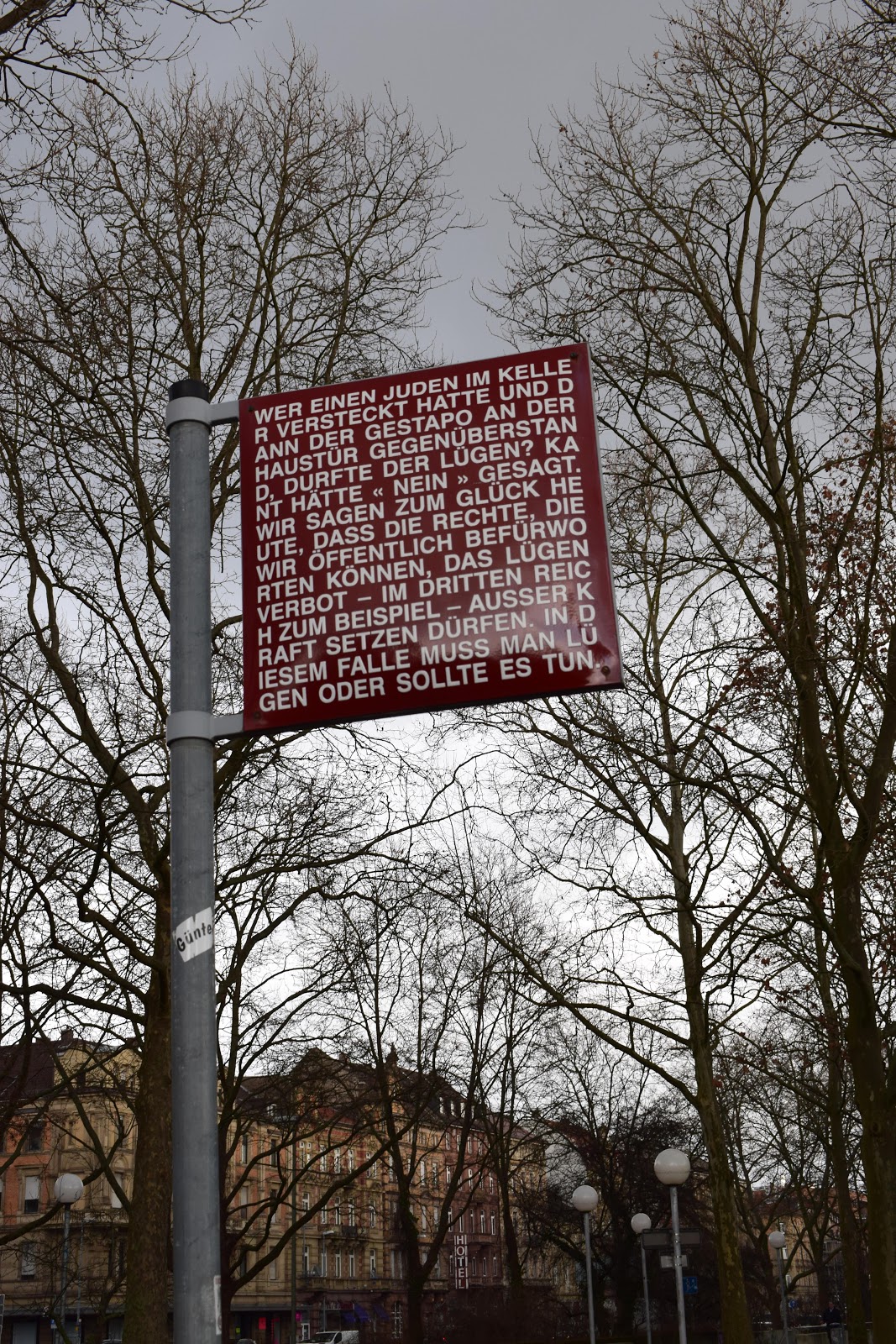
Since October 2005, Karslruhe has also a Square of Human Rights - Platz der Grundrechte - inaugurated on the 50th anniversary of the founding of the Federal Constitutional Court. A project of Joachen Gerz, the aim is to make the idea of rights as a tangible value. 24 Metal squares attached on poles have written with capital letters on one side statements made by legal practitioners, scientists and legal experts on human rights issues, with on the other side statements from people in conflict with the law, 
In 2015, Karlsruhe celebrated with a year-long festival 300 years since its founding and many of the buildings and main sightseeings received a serious lift. But when you want your city to look almost perfect, the work is never over. As my visit was in February and the touristic season was not officially open - except the regular French visitors, as the city is less then one hour away by train from France - many important buildings were surrounded by construction works. For instance, the famous pyramid and the entire marquet square area, including the historical city hall. 
Until the final works are done, the visitors and locals can spend some good time discovering other cultural offers, such as the Badisches Staatstheater, built in the brutalist style of the 1975, serving as both a theatre and opera house, with a very rich repertoire, appealing to many age and educational categories. 
One of my biggest regrets during the intensive 48 hours spent in Karlsruhe was that I didn't have the chance to explore properly the food scene. Except for breakfasts, I tried to use my time between touring the city and visiting locations on my bucket list situated less than one hour distance, such as Baden-Baden or Pforzheim. The city has many interesting restaurants, especially African and Eritrean, which deserve an extensive tasting tour. For one lunch, I tried Viva Heute Vegettarisch, a vegetarian buffet offering a variety of meals for affordable prices. 
If you are a lover of arts, Kunsthalle is a destination that should be included on the to-do-list, with some good hours reserved to explore. It has an impressive collection of Dutch paintings and European works of arts in general, hosted in a classical temple-like building. Surprisingly, paintings considered 'outrageous for the public view' were decently hidden beneath silky curtains, the viewer being told to proceed to cover it after the view. For me, I think it was the first such 'modesty' experience in my whole eventful museum life. 
A couple of meters away, the Botanical Gardens are recommended if you are in need of a walk in the middle of a park made by beautifully organised alleys. 
Back to the palace - operating as a museum since 1921 -, I am spending half of an afternoon exploring the art and historical collections. From history of printing to the famous Black Forest wall watches, there are many things to learn on the way about the Karlruhe and the entire region of Baden-Württemberg. Until this June, an exhibition about life in Egypt during Ramses the Great, is another example of local interest towards the Egyptian culture.
The famous pyramid, for instance, was built following the Napoleonian interest towards the traditions of Egypt. 
At the end of such an intensive cultural journey, I offer myself a food staple from the region, a slice of the famous Schwarzwald Kirschtorte - Black Forest cake. I've tasted various variants prepared outside the region, but I kept being disappointed. However, the one I've tasted at the Palace coffee place, has a perfect melting of the different layers, covered by a very soft whipped cream, and based on a thin and delicious batter. 
There were many other discoveries I made during my journey to Karsruhe: The small Transportation Museum - Verkehrmuseum - open only on Sundays, where I got permission to take fast some pictures outside the visiting hours; the quiet morning streets around Hirsch bridge or the busy shopping centers like Post, hosted in classical museum-like buildings.
Although I only spent two full days in the city, I realized that I just got the taste to come back to see and discover more. Now, that I can coherently asking to anyone asking me: 'What can you do in Karlsruhe', I already have the plan to return any time soon for feeling more like a local than a busy tourist. I am sure there are many hidden gems waiting for me here.