Showing posts with label german castles. Show all posts

Branitz Castle: An English Garden Late Summer Dream

Visiting the Bad Muskau park and castle was a travel dream I had since moving to Germany, achieved only the last year. But I am living from a travel dream to the other, so shortly after I realized that I must see another work - the last - of the multi-faceted Hermann Ludwig Heinrich von Pückler Muskau, a general, writer and landscape artist, among others: Branitz Castle. Another famous work of him is the Babelsberg castle which I visited couple of times in the last months, preparing a post about my beloved Potsdam, coming up the next week.
Branitz is a small village near Cottbus - which is also worth a visit - reached by the bus no. 10 - Pückler Line - leaving in the front of the train station. In the weekend, there is a bus every hour, at past 8, and the ride takes around 20 minutes. Welcome to the world of wanders seems to be written all over the blue door!
The park is a fine work of English landscaping, the plans being coordinated by Pückler himself. The last of his works, as he spent his last years of life and died to Branitz, it has many interesting corners where the manmade landscape is insidiously invading the wild nature. The additions are so discrete that you hardly notice sometimes, therefore you might simply prefer to enter what was created for you, like in the old Chinese stories where the artist disappears from the real world by jumping into his work of art.
Even the architecture looks unusual, with normal shapes and volumes going through a dramatic metamophosis. A happy meeting between the world of creativity and that of geometry with its numbers.
I particularly loved how in the wilderness of the park, some discrete human presence can be enlightening. A reminder that you are not lost in the middle of the chaotic rhythms of nature.
In the centre of the park, there is the late Baroque castle, with its oriental rooms, and the special library and an impressive collection of items brought by Pückler from his travels around the world, where Clara Shumann and Felix Mendelssohn Bartholdy also used to play for the castle guests. 
The blue, my favorite colour, is everywhere, here also matched with the golden wrought of the entrance stair case. A group of young people celebrating a wedding are singing in the front, with some of the guests, dressed in colourful outfits, are running to be in time, colourful spots on the green background. It looks like the perfect setting for such happy beginnings.
The people are almost melting into the surroundings, easily being taken for one of the bizarre statues, which do have a classical Greek posture, but are ironically dressed as a modern work. In this respect, Pückler was also far before his time. 
With the sun up in the sky and promising to stay there for longer, I am following the paths, trying to not be bothered by the bikes or groups of people Nordic walking or many other visitors who are taking the same chance as me to be here. Especially if you are a local, it looks like the perfect way to spend outdoors a beautiful summer day and I am glad to be one of them today.
The grass-covered pyramid is another local attraction, near the small island where Pückler and his wife are buried. Passionate by Egypt, he wanted to create a corner of Orient in the middle of the cold Eastern part of Germany and at least visually, he succeeded to achieve something unique and unforgettable.
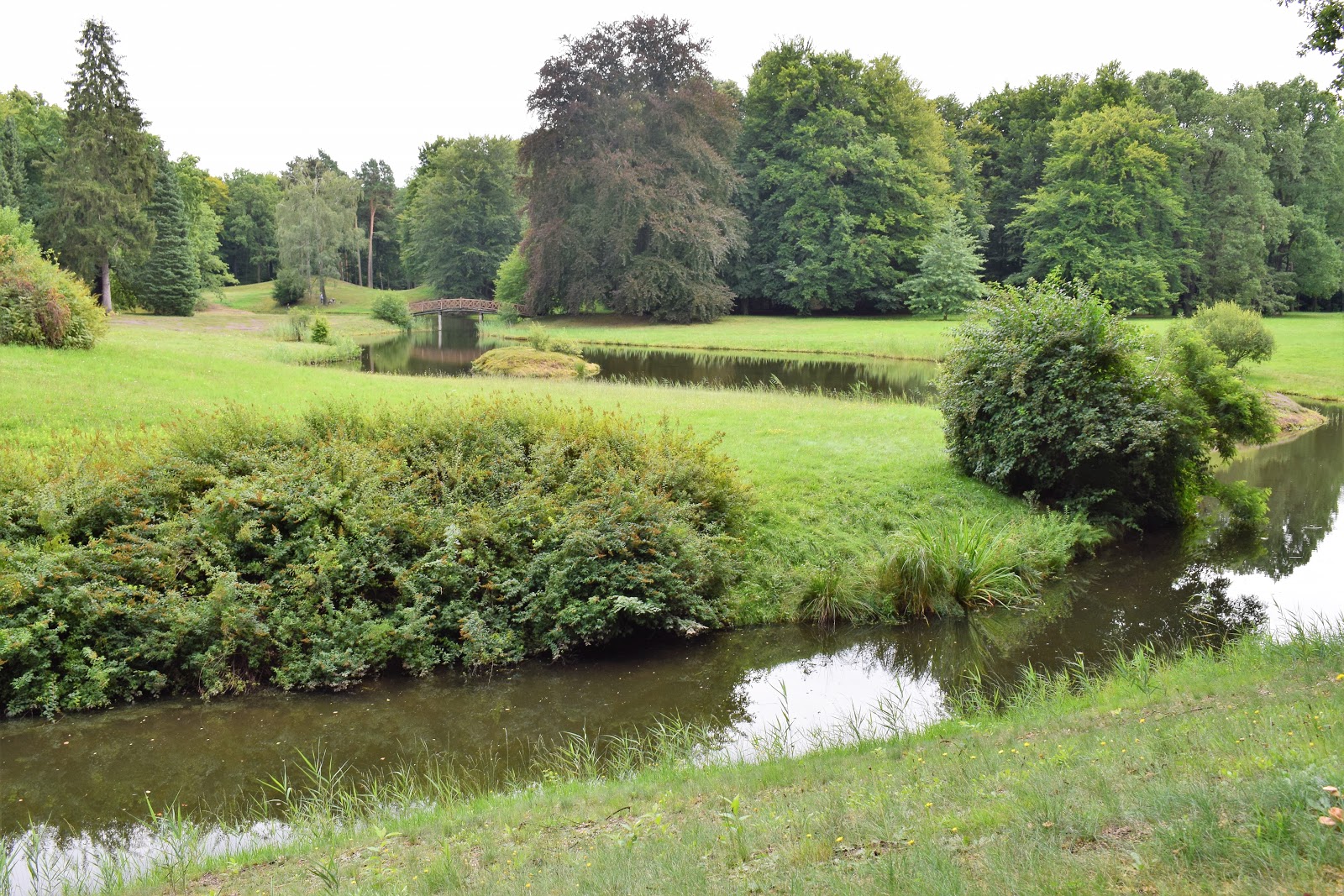
Although the strong fresh air is healthy all round the year, I will strongly recommend to visit this place when the nature is in full bloom and one can get extra beauty points by just looking at the lavish natural background. It took me a couple of months of waiting, but it was worth the effort and would love to come back here any time as long as I can see green pastures and colourful flowers.

Other things to do near the Branitz Castle:

Especially if you visit with children, there are at least two other things to do in Branitz, minutes away from the Park.
- The Tierpark, where you can, among others, watch from close some funny, friendly kangaroos. 
- Take a ride with the historical train. The train station is in the front of the Tierpark entrance and the kids do have a lot of fun riding through the forest and back. 
For more inspiration from Branitz, visit the dedicated Pinterest board: https://www.pinterest.de/ilanaontheroad/branitz-germany/

A visit at the Mirow Castle

There are many reasons why I travel: for visiting an iconic place, for discovering hidden histories - I have a PhD in history, after all -, for a special corner of nature or for a literary inspiration. All reasons to travel more are good, anyway. Mirow was mentioned to me last year, outlined as part of a German-UK connection therefore, I couldn't wait for the coming of spring for an extensive visit.
From Berlin, one takes one train until Neustrelitz, which I had the pleasure to discover last year, and from there, switched to HANS, a private line leading to Mirow. The ticket costs 4.40 EUR. one way, the ride not being covered by the normal Deutsche Bahn ride, a surprise not necessarily shared when you are buying your ticket from the machines. As usual in Germany, having some cash with you always helps.
The first minutes upon arrival in Mirow - whose name derives from the Slavic 'peace', meaning 'place of peace' - weren't impressing at all. A train station with the name letters missing, and a town which seems empty, although there are apparently around 4,000 people living here.
We followed direction Rheinbergestraße, and turned to Schloßstraße, enjoying the generous rays of the spring Sunday light. The feeling of being alone disappeared, as we were getting closer to the castle, as more and more people walking joined. 
The first stop was the heart-shaped Love Island, built following the instructions left in the will of Adolf Friedrich the VIth, the last reigning grand-duke of Mecklenburg Strelitz. His mysterious death in 1918 - suicide or murder - was not elucidated until today. Here is a short historical article, in German, about the possible reasons of his death. 
On the other side of the wrought-iron bridge, there is a ladscape of peace welcoming the visitor. The boats are shaking slowly on the water and the small fishermen houses are the only silent witness of human presence.
2-hour boat tours around the lake can be taken, if you want to get a full immersion into the peacefulness of the places. As Mirow is situated in an area surrounded by lakes, rivers and canals, it is a good way to get to know better the nature of Mecklenburgische Seeplatte.
As my time here is relatively limited, I focus this time to a visit at the castle. The construction lasted between 1749-1760, but as in the case of many such constructions situated in the Eastern part of Germany, it has assigned a variety of functions in the last 6 decades: it was the administrative office of the Luftwaffe, granary, a state retirement home or a school. 
The renovation works aimed at reestablishing the castle as a museum took place in the second half of the first decade of the 2000s.
The fact that in the last 300 years the rooms were constantly redesigned has its price, as you can feel the difference between the label of 'Baroque castle' and the relatively modest interior, if you compare to the beautiful appearances of places like the Schaetzlerpalais in Augusburg. However, the careful renovation work followed the original descriptions therefore, the Red Salon, lined with silk Chinese-style wallpaper makes an unforgettable memory of the visit.
Stucco decorations and carved corniches are amplifying the colourful effects of the distinguished wall-paper specific for each space. 
Mirow was included since 1701 into the domain of duchy of Mecklenburg Strelitz, and it is the birthplace of Sophia-Charlotte of Mecklenburg Strelitz, the Queen Consort of George III of United Kingdom. George III himself has German blood, his mother being Princess Augusta of Saxe-Gotha. He is the first Hanoverian monarch born in England and using English as his first language. The marriage with Charlotte resulted in 15 children, out of which 13 reached adulthood. In 1810 he was declared mentally unfit to reign. 
You need to slowly go from a room to another, trying to enter into the elegant mood that required a lot of work to be recreated.
Particularly the wallpapers are creating a special ambiance, modestly matched by the pieces of furniture and the floors. You may feel that things look too shining to be original, but at least it is enough room left for dreaming about the old times of the castle life.
I only have eyes for the walls, which are telling the best part of the story. The solitary piece(s) of furniture aren't convincing me too much about about how to include additional narratives.
My favorite room is the Embroided porcelain cabinet. After WWII the wallpapers, a textile materpiece, was hanging from the walls in shreds. Inspired by real pieces of porcelain, the figures on the wall are hand-made by needle, probably by a circle of women gathered regularly around Duchess Elizabeth Albertine of Saxe-Hildburghausen, the mother of Sophia-Charlotte.
The much praised Great Hall, where big balls and dancing parties used to take place didn't impress me. The stucco and statues - whose details can be closely watched through binoculars - look out of the space, and some of the putti are scary and greatly diformed. The only success of the reconstruction are the lamps hanging out from the ceiling creating together with the natural lights out of the window a certain vision of space. 
Outside, the sun is wrapping the carefully manicured English gardens. It is the best time for some little walking around, but unfortunatelly there was not too much place for the long walking I wanted to have around the lake. 
The fine mouth melting raspberry mousse cake accompanied by a cold coffee served at the museum cafeteria added some sweet taste to the trip, after so many hours of historical wanderings (and some interior design observations too).
We left behind the Mirow and his silences, thoughtful about the recent histories we've read. Although I would have love more nature wanderings, this time was a different kind of trip. I am sure that soon I will be back in the Mecklenburgische Seenplatte for more nature tasting and discoveries.

For more inspiration about Mirow, check the dedicated Pinterest board.

An afternoon at the Schwerin Castle

Image
I rarely have one single objective in mind when I visit a city, but as my trip to Schwerin was booked only 2 days before and did not have too much time to spend, I didn't look for anything else than the Castle. For a little bit, the fate tried to counter my plans: I had a 75 minute train delay - but the free coffee and the promise of a partial reimbursement diminished the tension, plus a couple of rainy showers. But when I want something so much, nothing can stop me!
I get to know the city through a little tour of the area around the lake near the Arsenal. Even though I spotted some tourist buses, all of them were heading to the castle so with the exception of seagulls, nothing bothered my first date with the city.
Image
As usual, I preferred to follow some hidden streets: followed August Bebel street for a couple of houses, and then Puschkinstrasse, till I arrived to Munzstrasse and Grosser Moor street, with a lot of art galleries, fashion and design shops. Everything was closed, but the rest was well deserved, after a full night of cultural happenings. A literary festival was ongoing, but I did not see anything taking place during my day. Many of the shops from the old part are hosted in old buildings, part of the local cultural heritage, and half-timbered houses are often used for private accommodations.
Image
Without acknowledging, I arrived close to the castle, but I wanted to taste it only at the end of my trip. You keep the dessert for the end of the meal, isn't it? So I wanted to increase my appetite visiting the exhibition of Dutch and Flemmish painters hosted by the local art museum. As this Schwerin institution hosts the most important collection of this kind in Germany, I had what to see for the next hour and the beauty of the Dutch art made me very happy and hungry for more.
Image
With so many big buses of tourists heading to the castle, no wonder that it was so busy and in some rooms not easy to move. The castle was initially built in the 10th century, but went through various changes and renovations, the most important occurring in the 19th century, after the castle was chosen as a residence of the Duke of Mecklemburg. The main conception belongs to the Berliner architect Georg Adolph Demmler, a brilliant student of Schinkel. The source of inspiration were the Loire Castles, especially Chambord. Even though I was not extremely impressed by the interior of the castle - big rooms, but a lot of wasted space - except the fine Italian marble bathed by the sun light entering through the portioned windows, I enjoyed its architectural presence. Looked from outside, it sent strength and fragility, delicate lines finishing by strong towers.
Image
I finished my tour in time in between two rain showers. The interesting statues added more strength to the overall perception of the castle.
Image
The gardens were designed by Lenné, in the usual Prussian spirit of order and symmetry, with a bit of beauty in the most unexpected places. The Orangerie, a cast iron construction beneath the terrace, was restored in 2001. It was still green, but I can imagine the beauty of flowers early in spring.
I had another look at the charming corner and hurried up to the train station. My spontaneous decision to spend the Sunday here was excellent, but I may want to return another day to see more flowers and eventually to take a tour of the lake.