Showing posts with label what to do in berlin. Show all posts

Sunday Walk in Pichelsberg

Caught between the noisy Olympia Stadium - especially when there is a soccer match going on, as yesterday - Spandau and Gatow, Pichelsdorf is one of those place you rather transit through than you stop. Without museums and any noteworthy restaurants or monuments, you rarely find it mentioned by the everyday Berliners, unless they are (lucky enough) to live there. But I believe in the charm of every single part of Western Berlin, and I am not afraid of the thread of boredom. I am rarely getting bored in this city - and during any of my travels in general - therefore I decided to spend a full Sunday afternoon exploring this part of the city. 


Once we are coming out of the 1911-built SBahn Pichelsberg station, all we can see are small one-storey houses surrounded by green yards and huge old trees. This is the predominant architectural style of this villa-residential area. 
Close-by, there is the so-called Britishen Siedlung on Kiplingweg, a couple of dozen of houses close to the then British Hospital and the British School - which nowadays is a private English-speaking school. Finished in 1958, by the team of architects Rudolf Ullrich, Alfred Gellhorn and Leo Lottermoser, it was aimed to answer the accommodation needs of the representants of the British Establishment living in this part of the city. Although the constructions look more or less all the same, what distinguishes a residence from the other is the choice of plants and size of the gardens, with the whole area looking almost like an enormous garden.


New blocks of flats are taking over parts of Pichelsberg too, but in a way which keeps in line with - at least - the average height of the surrounding buildings, although all of them are looking like copy-pasted Tetris blocks.  


When you are not having a garden party or an outdoor lunch in your home garden, you can find some small places where to spend your time and money: some small beer gardens or some Italian restaurants. Nothing fancy, minimal comfort and an usual menu, and good prices too. 


On a side street from the very long Heerstraße, it is situated since 1955 the Jewish Cemetery. It was created after the access to Weißensee - Europe's largest cemetery - was blocked following the division of the city. Here are burried personalities like the iconic Heinz Galinski, the leader of the post-War Jewish community in Berlin between 1949 and 1992, the chief cantor Estrongo Nechama and the representatives of the West Berlin Jewish families established in the city in the last decades.


A couple of meters away, on Heerstraße, there is another cemetery: War British Cemetery, one of the three Commonwealth War Centers in or near Berlin. Designed by Philip Hepworth, the principal architect for WWII Commonwealth War Cemeteries and Memorials in N Europe. Around 80% of those burried here - a total of 3,600 burrials - belong to the Royal Air Forces (RAF) Bomber Command. A number of 278 burrials are after the war. It is my second time here and I feel overwhelmed by the general feeling of stillness. No one around, only the thousands of replicated small white stones. 


Out on Heerstraße, the high buildings erected between 1968 and 1970 in order to accommodate the new needs of the West Berliners sprung from the tall trees. 


But the predominant architectural style of the area favors white, one- maximujm 2-storey family houses. Am Rupenhorn displays a couple of examples of architecture from the 1920s. One of the most famous is the building on no. 25 whose interior can be also visited by requests sent at least 2 days in advance.


Nature is inviting every tourn of the street and like the rabbit from Alice in Wonderland, invites to follow unbeaten path. As the entire area is on a small hill - berg means mountain in German, but in this case the term is slightly overrated - you can easily go up and down through small forests to reach small lake oasis or even to go as far as Grunewald - which is around 4 km. away. We are for the lake today, and the small port Am Pichelsee makes me forget for a second that I am only in an obscure part of Berlin and not in Monaco or who knows other glamorous place in this world.


You can easily rent a boat for a couple of hours or a day, if you are not lucky enough to have your own. On the street sides, glued on a tree, small anouncements on pieces of paper - the usual marketing Berlin-style - are offering boats on sale for quite good prices.


Under the massive metal feet of Stoßenseebrücke, both nature and boats and humans are grossly belittled. The association between nature and human work looks like a grotesque display of power.


Remains of former gates of entrance to Berlin add a majestic decay to the landscape. This area can be read in so many ways, from the old times to the industrial revolution era!


Times passed, the nature and their beautiful lakes stay always the same - maybe only a bit polluted by humans from time to time.


Time for a short snack, at a local fast-food establishment since 1961 - Ketch'up. The Frech fries are decent and the garden offers a pleasant oasis of freshness on a sunny day - plus live updates from the soccer championship!


Down on Siemenswerderweg, a short stop at the small boats port. People are waiting in line to rent a boat, with bags fulls of bottles of beer on the side. Cheers for the neverending summer vibes in Berlin!
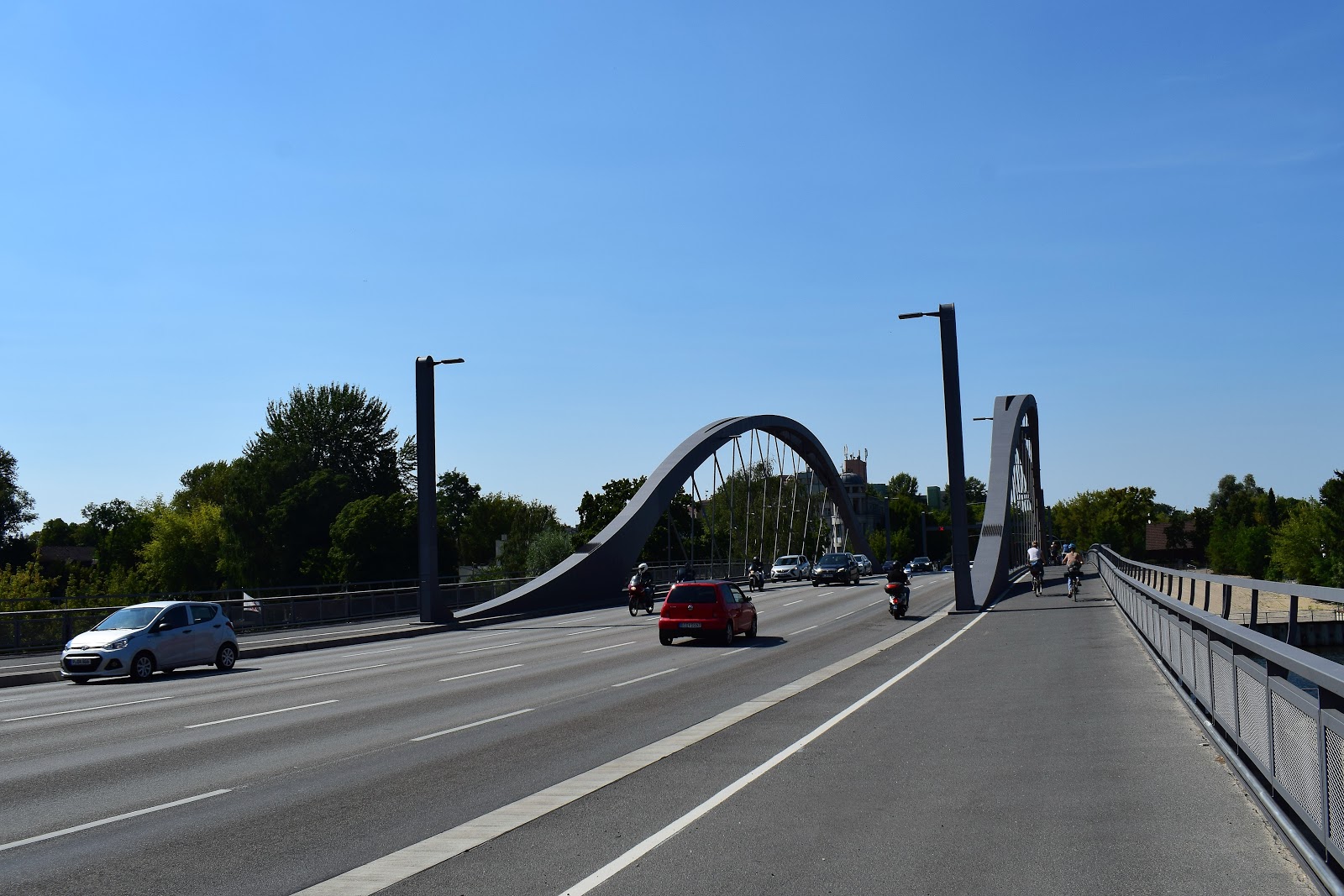

A couple of meters up, the Freybrücke, originally built in 1910 and reconstructed in 1950, brings you - on bike, at the wheel or pedestrian - near to Spandau.


The sophisticated construction of the bridge is countered by the pre-modern view of the surrounding natural view on the lake, where people are stand-up paddling or enjoying the pristine environment.


In Alt-Pichelsdorf, the enormous park is one of the most important highlight of an area where everything is small scale: the little shops, the Späti - small stores open round the day and night - the houses and their gardens.
As we are walking back the 2,5 km. alongside Heerstraße to the S-Bahn station, we stop for a little while more than once to breath a bit more this quiet feeling of slow life. The more I explore the West Berlin the more I realize that I would not be able to live anywhere else in this city.  

For more travel stories, follow my YouTube channel: https://www.youtube.com/@ilanatravels

Why Visit IGA2017?

Since mid-April, I am trying to save at least one day every week for going to visit the IGA 2017, but the weather was the worst partner ever in this project. How could I visit an International Garten Exhibition where beautiful flowers and gardens projects are displayed and writing about it without being able to take pictures with the rays of sun soaking the natural colours? The last week, things started to change, and I spent one of the few first days of the spring without any drops of rain outdoors exploring an unique temporary project.
The exhibition takes places until 15 October this year. For the 186-day duration, around 5,000 events - among which concerts and theatre representations - are scheduled. Full updates of the program are available on the English and German versions of the exhibition website. Initially, the exhibition - which is organised in Germany every 10 years - was planned to be held in Tempelhof the former airport turned into a public park, but it was transferred to Marzahn-Hellendorf, where the infrastructure of the Gardens of the World was already available, to which a couple of more hectares were added where new constructions were built and new project created. 
As I went to the Gardens of the World several times, I rather preferred to see the newest additions, including the cable car which connects the old and new part of the park, with an overview over the flowers exhibitions and the various other projects developed. The launch of the project was accompanied by a new refurbishing of the metro station Kienberg-Gärten der Welt - which looks just modern but without any special personality as many of the metro stations I featured in my post dedicated to the most beautiful metro stations -, which can be easily accessed via U5 line. With the S5 from Spandau, Zoologische Garten or Alexanderplatz, the train should be changed at Wuhletal station. The duration of the ride is about 45 minutes. If you arrive by car, there should be some problems as there are no parking spaces available around. 
In most cases, IGA 2017 is easily accessible to persons with disabilities and families, with elevators and ramps facilitating a best overview of most places of interest. Particularly for children, there are so many parks and playground where children of different ages can have a great time outdoors. 
Near the main entrance, for instance, there is a big playground inspired by the works of the beloved German children author Erich Kästner. 
Age doesn't usually matter here, as you can enjoy your childhood memento on the top of one of the hills playing on a swing, eventually barefoot for touching the small heaps of sands underneath. Time to dream about the location of your summer holidays.
The ambiance of the natural paradies continues in the Arche Park, where horses or sheep are freely roaming around. Maybe a relaxing gateway in the countryside suits you better?
There are many places where one can meditate about the future, including planet's. Bridges made of recycled metal brings you in the middle of wilder nature patches.
The campus area is designated to teach about environmental protection and teach young people - as young as from kindergarten level - about how to be more careful about our green heritage.
The architectural structures easily integrated into the natural landscape are confirming this frame of mind focused on creating more awareness about the environment among different generations.
At IGA 2017, one can touch, see and learn from first hand sources about various farming conditions of different types of grains or about the life of the bees.
Creating a huge installation out of the eco-friendly and sustainable bamboo boosts the limits of creativity in architecture, while keeping in mind to use technologies that don't create chemical pollution or any harm to the environment.
The area designated to introduce nature-related projects and to offer additional information about plants and green cultures is fascinating, especially for someone that has spent too much time in the urban areas. For instance, the small vineyard created where I hope to return in autumn when maybe some drops of fresh wine will be available for tasting.
Or the little igloo where seeds and plants and micro-level cultivation techniques are introduced...
Or how to create eco-friendly roofs made of recycled materials...There is so much to learn that I almost forgot that I only have only one full day to spend here this time. 
Making your way through the over 100-hectare park is very easy due to the directions leading you to different attractions. If you have comfy shoes you can easily walk slowly for around two hours until you make your way to the Gärten der Welt side of the Exhibition. Just in time to see the last breath of the cherry blossom trees.
The silent Chinese Pavillion, where the tea can be sipped as in the Imperial times, remains unchanged, even nowadays the curious passangers from the cable car might be intrusively overlooking the tea-lovers.
This slice of Asian peace remained unchanged so many years after my first visit here.
If you visit the Gärten this time of the year, you can fully feel the spring in all its fragrances and colours. For instance, wisteria, which is a rare appearance in the Berlin catalogue of flowers.
Children are invited to visit a Brothers Grimm thematic park, with representation of different stories by the famous German story tellers. I may confess that with some exceptions, many of the characters were completely foreign to me so it is about time to return to some basic bibliography.
Hopefully, there are many friendly characters, out of the classroom, which can entertain and make a trip with the children an enjoyable experience.
As during my previous visits, I enjoyed spending some time in the Japanese gardens and their balance between nature and man-made constructions...
...or to wander near the temples' gates of the Korean gardens.
But there was also something new to explore, the Balinese Gardens where it seems that the rich and luxuriant vegetation of Indonesia was brought in the far Eastern parts of Berlin.
As I spent some good time lately at the Botanical Gardens in Berlin - a video displaying the beauty of this part of the world being under editing right now - I was reminded one more time about the preciousness and fragility of our eco-system.
And how else one can celebrate the beauty of nature otherwise than by dancing under the fresh wind of summer, surrounded by interestingly manicured trees and a symphony-like beauty of tulips of all colours, in different stages of blossoming.
The journey at IGA 2017 means more than a hiking trip well-spent taking pictures of flowers. With all the knowledge about nature and the inspiring beauty of flowers, it can be compared, at a lower level though, with the inspirational journey of the prophet Jonah, whose Biblical whale was built in the middle of one of the many playgrounds.
I cannot leave the Exhibition without using the opportunity of having a ride with the cable car. It goes smoothly on the top of the park, with a perfect view over the entire area through the window walls. At mid-way it stops for the exceptional construction of the Wolkenhain, which offers an overview of the Eastern part of Berlin, including the famous TV Tower. During the night time, the entire construction is illuminated creating an impressive visual effect. 
One can reach the top with the elevator or by using the stairs, eventually with a stop at the small coffee at the ground level. Food- and coffee-wise, IGA is providing many resourceful stops, serving mostly snacks and icecreams, without anything noteworthy from the point of view of the gourmet option. Hopefully, you can easily buy bottles of fresh water for a well-hydrated journey through the many wonders offered at the Exhibition. 
From the top of the terrace, you can reach far-far East beyond the typical communist constructions of the Plattenbauten which are surrounding the area and are visible anyway, until you can spot the vivid yellow raps camps and the gigantesques windmills. The green patches are beautifying the ugly concrete constructions - I know that those constructions look so fancy and fashionable for expats, but nothing will convince me that besides the affordable rent prices there is anything else to like about living in such boxes of matches. 
Berlin is a city smart enough to give you serious reasons to stay more and explore its insides even longer. IGA2017 is another example of the unexpected potential of this city.