Showing posts with label one day trips from berlin. Show all posts

Joy of life at Ludwigslust

If someone asks where the highest concentration of castles in Germany can be found, Bavaria is automatically mentioned, but besides this part of the country, other areas, including in the former East, do have many interesting places for castle-hunters. Mecklenburg Vorpommern is one of them, and after a couple of experiences at the beautiful Schwerin castle or more recently in Greifswald, one of my new year travel resolutions was to explore more of this area. After a serious documentation, I decided for Ludwigslust.  
With the ICE, there is one hour of smooth ride until the destination. From the train station, I slowly followed the directions until the central area, passing near castle-looking red bricked houses. 
Kanalstraße is made of a network of bridges connecting the main street to entrances to mansions or schools. I visited on a Wednesday and the streets were mostly quiet, with a sense of calm that may be hard to find in the big urban agglomerations.
The sense of balance is given by the classical shapes of the houses on Kanalstraße, many of them painted in pastel colours of pistachio or even light shades of pink. After so many red-bricked serious constructions it brings a sense of joy around, even though there are not too many people on the streets to share the feeling.
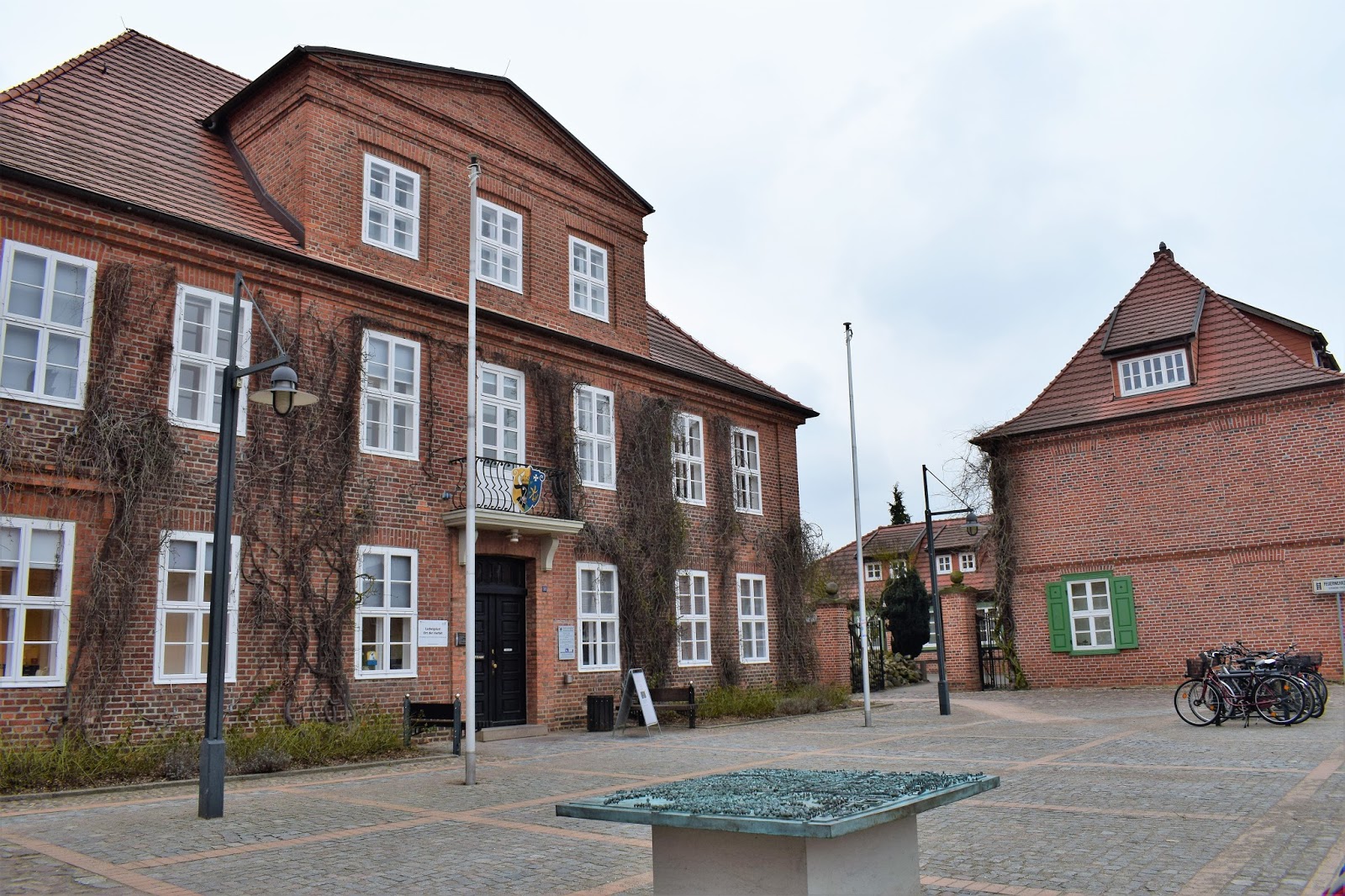
From there, we arrived directly at the busy Schloßstr., the street where the main shops, restaurants and institutions are situated. We are back to red and a sense of seriousness. The small city hall - compared to the majestic buildings hosting such institutions  -, with a metal mold of the city close to the entrance, is the historical place where the papier mache used for the decorations of the castle was created, between 1780 and 1871. In 1876 the building was assigned as a city hall, and in 1945 was also used as a police station and prison. Near the city hall, there is the Information Center where the visitor is generously offered a lot of directions and interesting details about the city. A very professional service that deserves my fully appreciation. 
On the other side of the street, another important institution for the German localities - the Post Office - reminds me a bit of the special architectural style of the buildings in Greifswald.
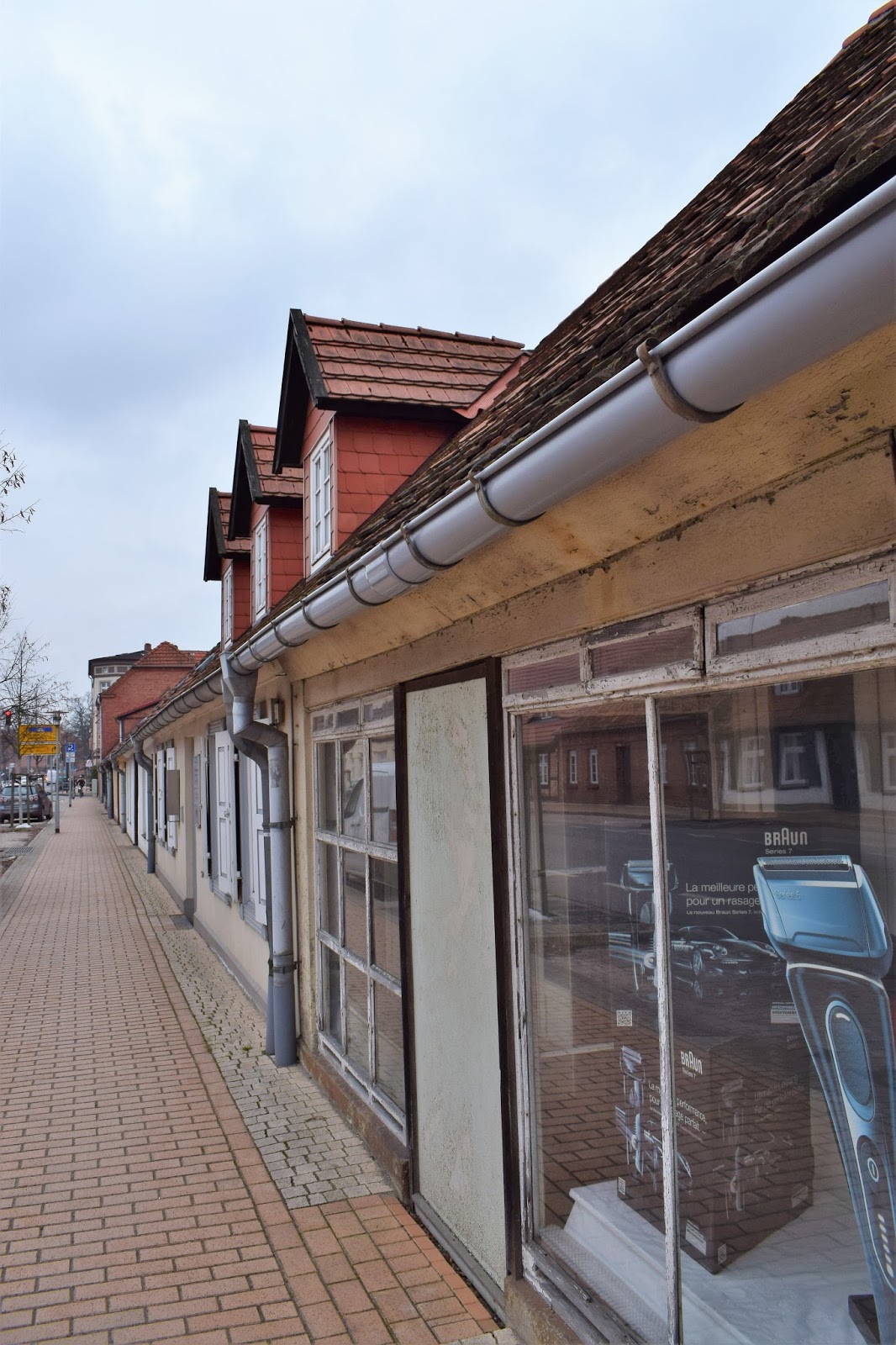
Generally, everything in Ludwigslust is about small sizes. Like the disciplined lined houses on Lindenstr. looking well suited for small people like me. Or for anyone interested in minimalist living in general. 
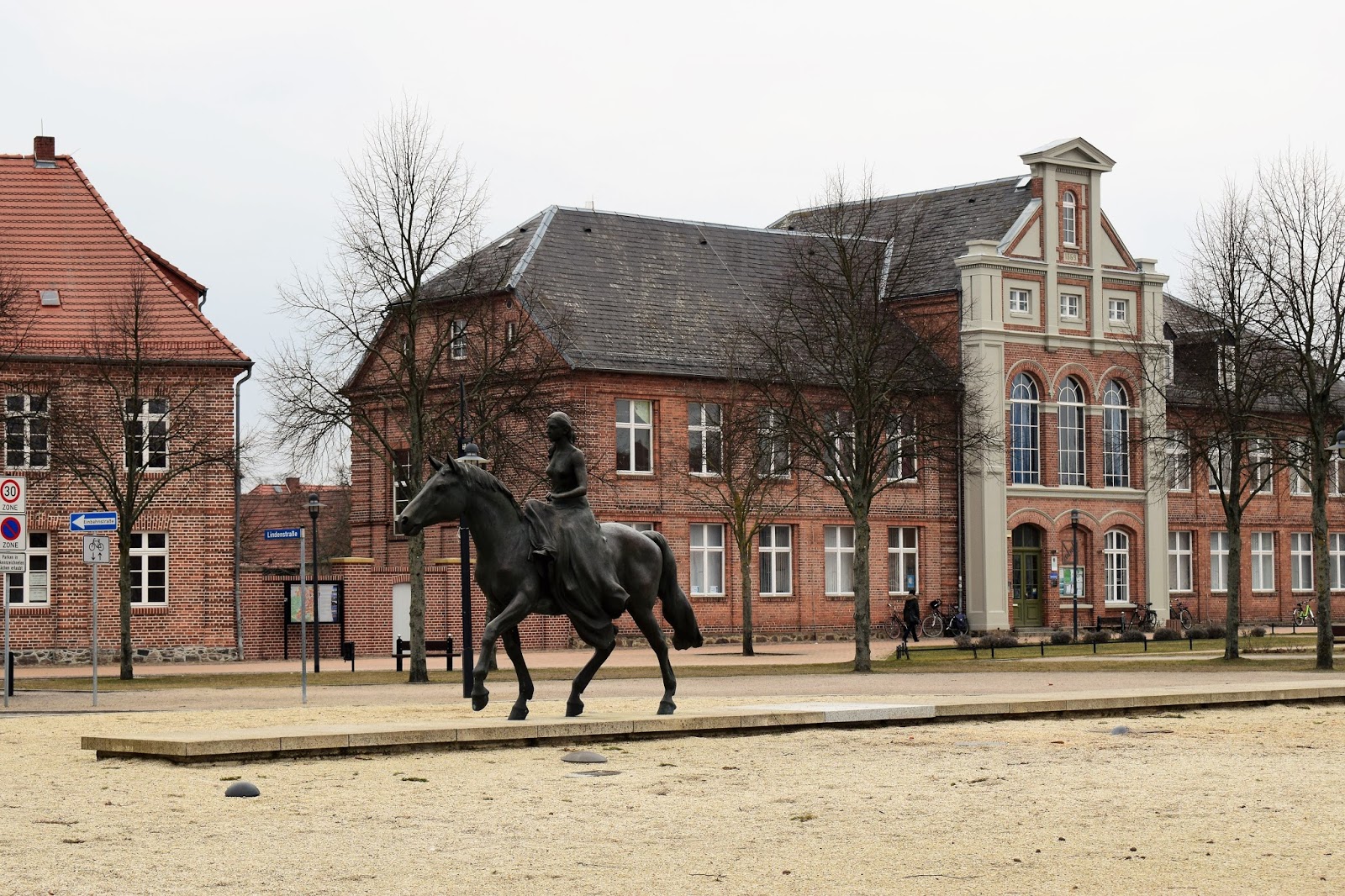
On the left side, Schloßstr. ends in a round square - Alexandrinenplatz - surrounded by red-bricked buildings, with a representation of a local princess on a horse in the middle. From there, you can arrive in the very modern shopping center of Lindencenter
A city visited during the gray months may give the visitor a completely wrong impression. Unless you have discovered some colourful spots. All over Ludwigslust, the covers of electricity - or phone - boxes are painted with scenes inspired by musical activities. A very welcomed initiative. 
After another ten minutes of wandering around, I arrived in the close vicinity of the castle that made this town famous. A couple of meters away in the front of the entrance there is a system of waterfalls created to add more impetuosity to the construction. Mythical stone representations in Baroque style are recreating a new symbolic world. 
And there is the castle, a huge construction made of small rectangles of windows added layer after layer. Without the statues on the top of the terrace roof edges, it would have been just a classical building, but the statues bring an air of mystery - especially if wrapped by the night lights - and joy.
At each corner of the castle, a statue with clothing details very well represented is carrying a lamp. We are still talking about classical style, but the baroque will soon challenge completely the rules of the artistic game bringing closer the modernity.
And there is the interior of the castle revelaed, that may surprise you compared to the classical facade. Now, you are getting closer to understand the reality of its name - Ludwigslust - Ludwig's joy. In the first half of the 18th century, Prince Ludwig, Duke of Mecklenburg Vorpommern started the construction having in mind initially a hunting lodge. But the more the plans advanced, the more the castle was becoming a refuge and a work of art aimed to enjoy the eyes of the residents. As the costs were increasing dramatically, Prince Ludwig decided to use instead of the usual gold coverage, papier-mache, produced at the local factory. Uniquely in the world, the overwhelming majority of decorations are made from this special material, that at least visually, creates the same effects as the expensive stuff. Everything is about knowing how to enjoy life, after all.
The first room you are introduced is the enormous Gilded Hall, with its high Corinthian columns and the enormous 4 candelabra - representing the four seasons -, produced in Rostock, a destination by the sea in the North of Germany. On a classical music background, the story of the castle is told through a recording, long enough to have time to admire every inch of the room. The Victorian lamps were designated by Schinkel and are made of wood bronze.  
For almost hundred years, between 1765 and 1857, Ludwigslust - whose castle is often called the Versailles of the North - replaced Schwerin as the capital city of Mecklenburg. The throne hall shows the symbolic place and activities taking place in the castle. The floors with small tiles creating extraordinary perspective effects are another noticeably element of the interior design of the castle. 
The castle is in permanent renovation process, with many halls and rooms still under reparation. The latest stage lasted around 6 years and was dedicated to re-open to the public the painting collection. The art lovers can admire at the castle an impressive selection of Italian painters, but also Dutch and French, many of them made by various court artists invited from all over Europe to Mecklenburg.
Each room has particlar elements of decorations, with mirrors creating the impression of bigger spaces and the golden decorations outlining beautiful details of every corner. For every space and detail of the castle, extensive information in both English and German are available, which helps the visitor from abroad or the neighbouring city to better understand the history and the cultural meanings of the place visited. 
As the initial destination of the castle was to be a hunting lodge, there is no wonder that one can admire here the monumental hunt game pictures by the Rococo French painter J.-B. Oudry, whose works I had the occasion to admire also at the Musee des Beaux Arts in Nantes. Duke Friedrichs was also interested in clocks and various technical mechanisms, and an intresting collection of clocks can be admired at the castle too, besides hunting gear. 
Every room has its charm and observing the fine decorations made out of papier mache increases the admiration for human creativity and innovation. With so much work underway on the other side of the doors of the rooms, I can't wait to come back to see more beautiful details brought back to life.
It is a crispy day, with the cold strong enough to kill the joy of life. The castle is surrounded by a 120 ha area of garden.
At the time of my visit, everything was frozen and not necessarily inviting. However, both local people and various presentations of Ludwigslust recommend the castle's garden as a must-see destination during the spring and summer months, particularly for the tapestry of flowers and the various art works created by flowers. A serious reason to come back soon in the next months to see what the serious German travelers consider as one of the most beautiful gardens in the country.
Close to the castle, near the park, there is the Natureum, considered the oldest house in Ludwigslust, hosting the first natural museum in Mecklenburg.
Before leaving this town, I want also to give a try to the local food selection. On the way to the castle, I spotted many bakeries or even a coffee house with classical sweets, like Konditorei Uplegger. For my lunch, I decided for Tutti Gusti, on Schloßstr., offering Italian - Sicilian influenced - meals with a Middle Eastern flavor. The interior didn't look special or very much took care of, design-wise, but the service was very fast and friendly. My first meal was a canelloni with spinach, in a generous gorgonzola sauce. Brough warm, it had discrete traces of nutmeg that balanced the saltiness of the cheese. 
The dessert was a special combination of: figues in orange sauce, with green pepper covered in icecream and wipped cream. It sounds delish and it also tasted so, even though a bit too sweet and without noticeable influence of the green pepper. 
The prices are fair and given the high concentration of people in this place during the lunch hour it means that this is a loved spot for the locals as well. 
Those looking for local products in Ludwigslust may be interested in the sea buckthorn, which is used here not only for syrups and jams and different food-related products - including honey, but also for soaps and beauty industry items, such as shampoos or hand creams. Lovers of nature may be interested to visit this town during the hot season, for following the different biking routes, horse-back riding or short boat tours. 
The colder and unfriendlier the weather, the more motivated I am to find interesting spots that can reward the effort of a trip here. I am walking the cobblestone old streets and the discovery of just another house sharing an example of local architecture is a pleasure both for my eyes or for the camera.
As usual on my trips, I keep an eye for interesting and colourful doors, and on the way back to the train station via  Kanalstr., I've discovered at least one beautiful work. 
And I would have still discovering more and more new spots and angles, if the time for my train back to Berlin wasn't getting closer. I gathered enough impressions and stories for a first visit, and I keep in mind this destination for a next travel adventure in the coming months. 

My newest discovery: Rheinsberg

Summer Sundays in Berlin are beautiful, but I am somehow restless these days, always looking to see more and more new things outside the city. Because in the last weeks I had enough time to see almost all exhibitions and newest cake and coffee places in town, why not trying a new adventure from the series 100 Places to See in Germany? With a Brandenburg Ticket in my pocket I headed to Rheinsberg. Let's the discovery start!
This small and green coloured locality is situated 2 hours away from Berlin. The train changed directions a couple of times, and I had time to say hallo again to Neuruppin, another recommended destination for those looking for a quiet Sunday afternoon. Did I already revealed the happy ending of my stay in Rheinsberg? Haven't say the whole story yet.
ImageAfter I pick up the destination for the Sunday travel, I did my documentation homework, but apparently there were some information that I missed: the long history of ceramics. The first factory was created in 1762 and since then it continued to produce various colourful plates and cups. I've read all the history in the cups of tea and coffee presented at the Keramikhaus, a shop open daily close to the Carstens porcelain factory. Carstens introduced in Germany the tea service in 1901, almost 20 years after the UK. Its specific mark is the deep black with various email decorations. Also characteristic for the local porcelain is a certain marble appearance, that gives a certain weight to any small cup of tea.
A couple of minutes later, at the Tourist Information Center, I was admiring other ceramic works, this time done some local artists in glass and marble porcelain. A similar exhibition was also available at the small Museum of Ceramics, situated close to an open market where a big fair of pottery will take place mid-October.
For the next hour, I continued the exploration of small streets and had a look at the architecture of the places and checked some of the local menus. Rheinsberg reminded me a lot of Potsdam - no wonder as the famous Friedrich left some architectural traces here too - but less touristy. One of the reasons of the relaxed ambiance can be that it is not that close to Berlin, and the connections by train are limited to the summer time. The train that brought us there will stop operating from mid-October till the next spring. However, the accommodation offer is richer meaning that people keep coming here during the winter too, with all categories of hotels plus a lot of private rooms offered. There are also a lot of restaurants and icecream parlors - one of them offer a different type of icecream each day of the year, among the previous flavours being mayonnaise, strawberry/basilicum. The restaurants are serving a lot of fish-based meals - fishing is a common activity in the area. One of the famous restaurants here bears the name of Kurt Tucholsky, the rebel author who apparently was almost everywhere in Poland and Germany, including in a small town at the Danube where he was an apprentice police chief for a couple of months. A Tucholsky literature museum can be visited at the Castle, my next and most pleasant stop of my destination.
ImageThe most pleasant experience I had by far in Rheinsberg was the long walk around the lake visiting various domains of the castle. Initially the property of Friedrich the Great, that was intimately involved in the planning of the domain, especially the gardens, it was later transferred to his brother Henryk, who continued the work and brought some of his architectural ideas. Nowadays, the castle looks as a perfect Romantic retreat: a big castle in the middle of the lake, with a baroque garden and boats, with a wonderful green wild walking area through the woods, where you can find ruins of Temples and an obelisque with inscriptions in French in the memory of the 18th century wars. 
My next 5 km of walk and around 2 hours of my time were spent walking around Grienericksee, breathing deep the silence and the fresh air of the woods, with only short stops to take some pictures and gulp some water. Because the access to the castle is not possible by bikes - the coblestones from the yard and garden are very fine and can be seriously damaged by the rolling tires - I did not care too much to watch my path. We crossed path with many groups of tourists, including a family with children looking for a place to camp, but did not feel like the forest is very busy, as it happens sometimes in Berlin where I feel like somewhere close to a shopping center. 
ImageI had the luck of a perfect weather, despite some threatening clouds at the horizon, and the perfect time of the year for a long walk in the woods. On the way back to Berlin, I felt a bit tired, but carrying on a lot of good energy that may help me to resist the urban life for another couple of days. The next time I don't have scheduled travel plans, I will return to Rheinsberg. It has the simplicity that I need for a perfectly relaxing time.
For more visual insights of Rheinsberg, have a look at the Pinterest board: http://pinterest.com/ilanaontheroad/rheinsberg-brandenburg/

Spring Western adventures in Templin

DSC09538
One year ago, I celebrated the beginnging of a beautiful spring day in Templin, and 12 months after I was back in the small Brandenburg city which is the hometown of Germany's chancellor Angela Merkel for exploring the other part of the city.
DSC09543
Shortly arrived in the train station, I headed direction Westernstadt, an adventure park that promises a lot of Western-like experiences. Although there is a bus that connects the city to this area, it works only during the week and thus, I had to walk a couple of kilometers. Luckily, the weather was nice and the road was quite sure. Close to a wood deposit, a train platform was presented as a possible attraction for visitors, but there were no one to give more information about tickets and schedule. Maybe later in the year...
DSC09552
After another half an hour of walk, I stumbled upon a small antiquities shop near the road, stuffed with everything, from old family pictures to metal garden tools and furniture.
DSC09556
Nothing compares though with the view of beautiful horses enjoying too the coming of the spring. In the quietness of the place, they offered a silently moving fragment of life and beauty.
DSC09560
But what is this noise? The serenity of the previous scenery was suddenly interrupted by the broken sound of repeated shootings. Hopefully, it was no war or frozen conflict getting heated nearby, I was just approachign the destination of my travel day: Westernstadt.
DSC09566
With most part of the activities taking place open air, the Western City is usually open from April to November, between 10am and 6pm. It has a huge parking place, as the car is the easiest transportation during the weekend, when the bus is on break. I arrived shortly before closing -something went wrong with my time management the whole day - but not late enough for not seizing the local ambiance.
DSC09567
There are different experiences offered to the big and small visitors, from photo boots where you can picture yourself and your family in the specific ambiance to live shows.
DSC09568
Beautiful horses are patrolling the sandy streets of the city, friendly enough for being approached by children.
DSC09572
Once in a while, one can also learn some country dancing steps. You are in El Dorado, after all...
DSC09577
Everything I go, I was more and more getting into the local feeling. Some colourful totems at a crossroad encouraged me to explore more the place instead of going down near the lake to see admire a quiet slice of nature.
DSC09582
If I would have been a child visiting Western city, it would be hard to resist the temptation to hide in one of these tents hidden beneath bushes. DSC09585
There is also a little animal farm and an adventurous playground.DSC09591Don't forget about the golden washing places as being in El Dorado always involved the search for some precious gold. DSC09595
Just in case, if you need to defend your treasure, you can get some special shooting training for being ready to react against your enemies, just in case...DSC09598In the saloon, the dark corners gives you intimacy and the time to think where can be the best undiscovered source of gold. As the closing time was getting closer, groups of parents and their children were heading to the exit and doors were locked behind. The silence was taking control of everything and sooner, the lack of movement will wrap perfectly the entire place.DSC09618Remnants of some communist youth activities on a wall near the Westernstadt were reminding that Templin used to be part of the red part of Germany. But right now, there is the Western spirit who won and with the new constructions being built ahead, those times will be soon only history books memories. DSC09627For me, it is about time to take the road back home, walking my portion of kilometers on the way to the train station. At mid-distance, I made a stop near a beautiful lake, that confirms the fame of Templin as the 'pearl' of the natural area of Uckermark.
 DSC09634
The huge storks hosted on the top of houses kept me company most part of the hiking. Maybe I did not spend a full day in Western style, but at least I was back in time to check how the winter finally surrended to the sunny spring. See you in one year, Templin?
Disclaimer: I was offered a free entrance to Westernstadt, but the opinions are, as usual, my own.
For more pictures from Templin, check the dedicated Pinterest board: https://www.pinterest.com/ilanaontheroad/templin-stadt/

The accidental discovery of Fürstenwalde

I like to plan in detail my trips, but when my homeworks are done and I saw everything from the list, I can't wait to go on the unbeaten path and try something spontaneous. Full of energy and good ideas from my trip to Bad Saarow, I realized that I still have some time left to delay for a couple of hours my departure from Fürstenwalde to Berlin. As the trains go to the capital city each hour, I tried to be as fast as possible for exploring the this little place on Spree in only 3 hours. 
Image
I did not need to get panicked that I will not be able to properly see Fürstenwalde, as a big map near the train station mentioned the main attractions and the streets directions. I took the way to Eisenbahnstrasse, a street bordered with a lot of more or less cheap shops. Using my camera as often as possible to catch the unexpected newly painted buildings with shy Jugendstil decorations, I arrived at the old Jewish cemetery. After being mesmerized by the strange architecture of the houses in Saarow, the bourgeoises houses brought me instantly back to reality.
Nowadays, the cemetery hosts only a dozen of graves and you can enter only with the key available at the City Museum, situated around 20 minutes away. The first Jewish grave was attested in 1746, but the cemetery as such functioned since 1829 till its destruction in the 1930s. It was reconstructed in 2001. The Jewish community - the Gemeinde - was officially recognized in 1886, years after the religious service took place in private residences. On the place of the former synagogue is nowadays only a memorial inscription installed in 1980s, the place being used by private residents. 
Image
After an intensive tour of the city in less than 2 hours, I discovered a lot of pleasant corners. For instance, the cute Klawitter shop that has a lot of old objects and pictures from the old city, selling tea, wine and many handmade foods. The extensive shopping can be made at the Fürstengalerie, situated at the end of Eisenbahnstrasse. The city used to have an old brewing tradition. In the 18th century there were around 14 breweries, but none was left for the delights of the beer lovers of today. Before heading to the Spree promenade, I stopped by the Niederlangetor, the oldest construction in Fürstenwalde, built in the 14-15th century, used as a place for depositing good for sale in the Middle Ages. 
The promenade around Spree was quiet and except some children from Yuri Gagarin school learning to paddle, there was not too much action around. I enjoyed a quiet walk with the view of Spree in the front of me. A completely different Spree from the one I knew from Berlin, more self aware, wild, green and dominant. The river played an important role in the economic and political development of Fürstenwalde, as the main and most important trade connection with Berlin and further on, with Poland. 
Image
Back in the city from the green oasis of Spree, I found myself in the middle of a huge square, dominated by the Kaiserhof Hotel, the most rated accommodation here. As I would discover later by reading another of the scrupulous historical notes in German, I was in Ottomar Geschke Square, bearing the name of a socialist politician born here with an important political career in the later DDR. The same square has a Liberation monument and another one in the memory of the Soviet soldiers. The square used to be an important meeting point for traders since the old Middle Ages.
As many other former communist cities, there are still streets names after Marx and Engels, and some communist looking blocks of houses were re-painted in gay colours, so everything seems to be fine with that part of recent history.  
I arrived at the train station a bit tired,  waiting for my connection to Berlin on a bench while reading some easy books brought from home. From the end of the 19th century, the trains took some of the responsibilities of Spree in terms of bringing Fürstenwalde close to the 'big world'. The train station is operating since 1842, being considered one of the oldest in Germany. From 1911, it got connected to the relaxation paradise from Bad Saarow. Nowadays, it brings people close to Berlin, in less than 90 minutes. 
On the way back to Berlin I was thinking that maybe Fürstenwalde is not such a great tourist destination, but has a lot of historical secrets hidden around the corners of its white houses.
For more visual insights, have a look at my Pinterest board: http://www.pinterest.com/ilanaontheroad/f%C3%BCrstenwaldespree/